
Free ADHD Tool
ADHD morning exit rescue
Make the last twelve minutes visible: door time, the essentials, and the smaller version that still gets your family moving.
This is for the moment when a morning has already become noisy, late, or scattered. It does not fix every part of the routine. It gives the exit one small landing strip: what has to happen, what has to be found, and what can wait.
Use it on this page, copy it into a shared family note, or print it. There is no signup. Build the ordinary version first, then name the short version for the mornings when there is no time to negotiate the whole plan.
Make the exit visible in four small moves
The final twelve minutes
Give the family one visible route to the door before another decision has to be made.
Name the door time
Write the actual leaving time and the one thing it is for. A clear endpoint is more useful than a long ideal-morning list.
Choose bodies first
Use the ordinary getting-ready step your family already relies on. Keep it concrete and kind; this is the minimum for leaving, not a test of a good morning.
List required objects
Write only what this outing needs: one bag, keys, a form, lunch, or the object that causes the most last-minute searching.
Set the door cue
Name where the last items wait and what happens after the door closes. A tiny reset makes tomorrow's exit less expensive.
When the morning is already late
Say the short version out loud: "We are doing door time, bodies ready, required bag, shoes." Then move the rest to a later block instead of using the doorway to solve the whole day.
Use the small version before the spiral gets bigger
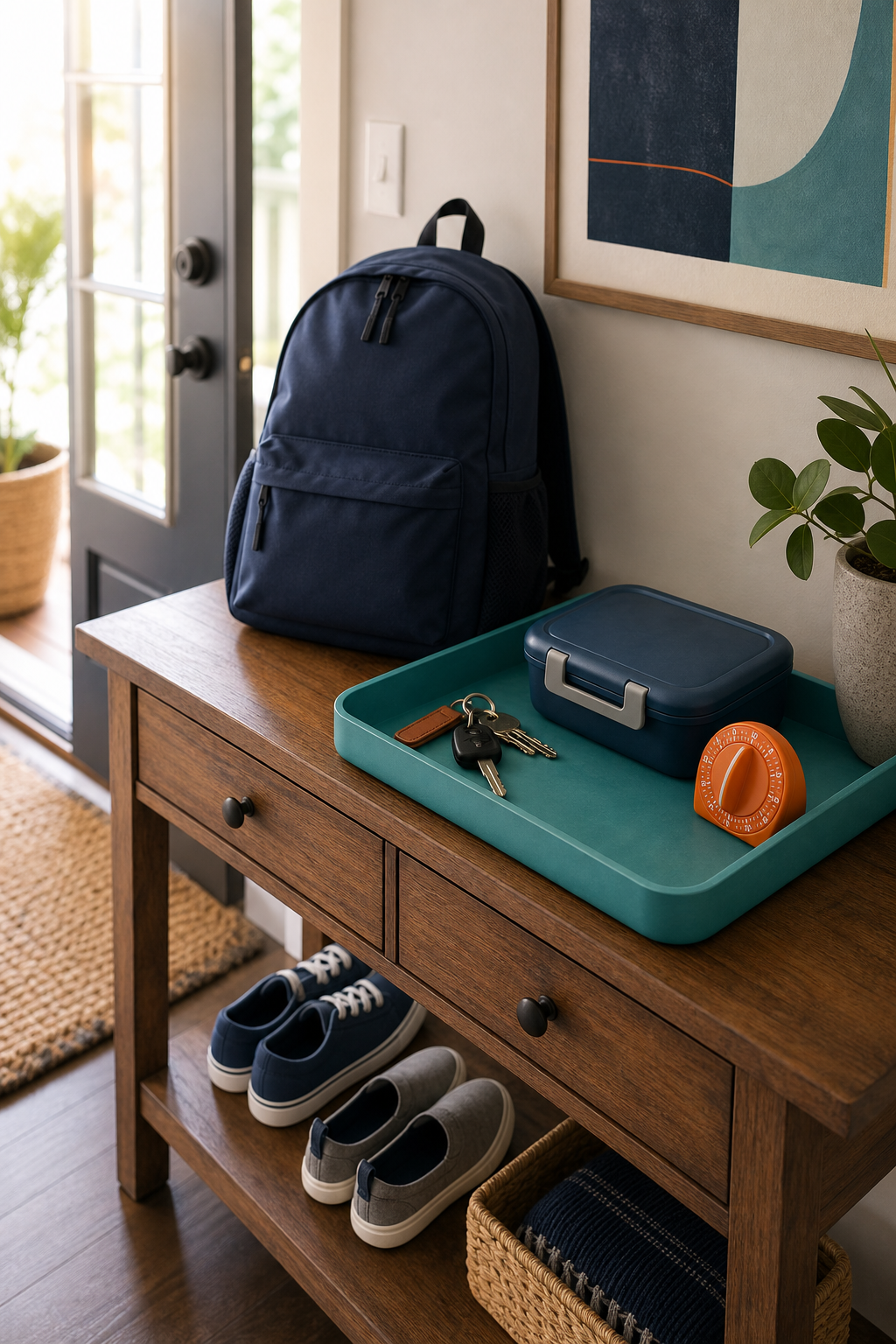
Leave at 8:05. Bodies ready means dressed and bathroom done. The required objects are backpack and library form. Water can be filled at the door. Shoes and form wait on the tray.
Leave at 9:20. Use the short version: bodies ready, one bag, shoes. Breakfast becomes the portable minimum that your household already uses, not another argument in the hallway.
Stop looking everywhere. Check the named door place, then choose the next workable move: borrow, replace later, or leave without the non-essential item. Keep the exit moving.
Use one plain line: "I am on door time. I need help with shoes or the bag." The exit rescue is a shared cue, not a reason for one person to become the whole morning dashboard.
Keep it separate from a complete morning routine
An exit rescue is deliberately smaller than a full morning plan. It is for the last minutes before leaving, when memory, patience, and time are all limited. Use the routines your household already trusts for health, safety, or care needs.
When the same thing fails twice, change the environment before adding another reminder: put the form in the tray, move shoes to the door, give the bag one hook, or choose a clearer time to start the short version.
When family mornings keep taking the whole day with them
Parenting Without the Overwhelm turns one exit rescue into a wider family system.
Parenting Without the Overwhelm builds on this first tool with visible ownership, family load maps, low-energy routines, morning and bedtime supports, and repair after hard transitions.
FAQ
What is an ADHD morning exit rescue?
An ADHD morning exit rescue is a short visible plan for the final part of leaving the house. It names the door time, the minimum body-ready steps, essential objects, and a short version for mornings that are already running late.
What should be in a morning exit rescue?
Keep it to four things: when you need to leave, the ordinary body-ready step your family already uses, the objects needed for the outing, and the place by the door where the last items wait. Avoid turning it into a complete morning schedule.
What is the short version of a family morning routine?
The short version is the smallest routine that gets everyone out the door for the specific outing. It might be bodies ready, one required bag, shoes, and the next move. Use your household's existing routines for any health, safety, or care needs.
Where should an ADHD morning exit note live?
Put it where the last decisions happen: beside backpacks, at the entry table, on the door, or in the family note you already open. A visible location does some of the remembering during a rushed morning.