
Free ADHD Tool
ADHD shutdown recovery reset
Lower the immediate demand, meet one ordinary need, and leave one small way back without forcing a full restart.
Use this when answering, choosing, talking, moving, or starting again feels harder than the situation appears from the outside. This is not a demand to get fully back online. It is a way to make the next few minutes less crowded, meet one ordinary need, and keep one small door open for later.
Use this page, copy the prompts into a note, or print it. It is an educational organization tool for reducing immediate demand, not medical, mental-health, diagnostic, or treatment advice.
Make the moment smaller before you make it better
One lower demand, one body minimum, one return cue
A shutdown moment does not need a complete explanation or a perfect recovery plan. Lower one piece of pressure, make one ordinary support easier to reach, and leave the next thing somewhere visible.
Name what needs to get easier
Pick the clearest pressure in front of you: noise, conversation, screens, messages, choices, movement, a task, another person, or the feeling that you must respond right now.
Meet one body minimum
Choose one ordinary support that is actually reachable: water, food, bathroom, temperature, a different layer, sitting down, a familiar texture, a quieter room, or a brief change of air.
Use a short holding boundary
Where it fits the setting, make a narrow boundary instead of disappearing into a larger problem. You may need a pause, a shorter answer, a delayed choice, or help from the right person.
Save one return cue
Leave one next action, object, time, or contact that future-you can find without reconstructing the entire moment. The cue can be smaller than the original task.
No restart deadline is required
The reset counts when one part of the moment is less demanding and there is one visible route back. You do not have to explain yourself perfectly, complete the original plan, or become productive again for this to be a useful pause.
Small versions that can fit real settings
Send a short holding reply if one is appropriate: "I saw this. I need some time before I can respond properly." Then place the full response in one return note instead of keeping it open in your head.
Close one screen, step away for water or a bathroom break, write the next work action, and use the shortest clear update the situation needs. A small container can be more useful than trying to finish through the fog.
Pick one function: sit down, drink something, get food, make the route to bed or the bathroom usable, or ask someone to hold a decision. The rest does not need to be sorted in the same moment.
Use the smallest honest boundary that fits: less talking, a pause, a change of room, or a time to come back. You do not owe a polished explanation while your capacity is low.
Write the next physical action on a card or leave the needed object visible. The return cue can be "open the calendar" or "put the form by the laptop," not a promise to complete everything later.
Recovery starts by lowering the next cost
A shutdown moment often gets treated as a failure to communicate or perform on demand. A more workable question is what the next minute is charging you for: input, decisions, social response, unfinished work, body discomfort, or all of them at once. Reducing one cost can make the next choice possible again.
This tool does not assume you can pause every obligation. Use the smallest version that fits your actual setting. That may be a glass of water, a one-line update, a quieter room, a timer, a holding note, or asking the appropriate person for help. The point is less pressure now and less reconstruction later.
This is an educational organization tool, not medical, mental-health, diagnostic, or treatment advice. Use appropriate professional or emergency support for any situation that needs it, and follow the relevant instructions for your health, work, school, or care setting.
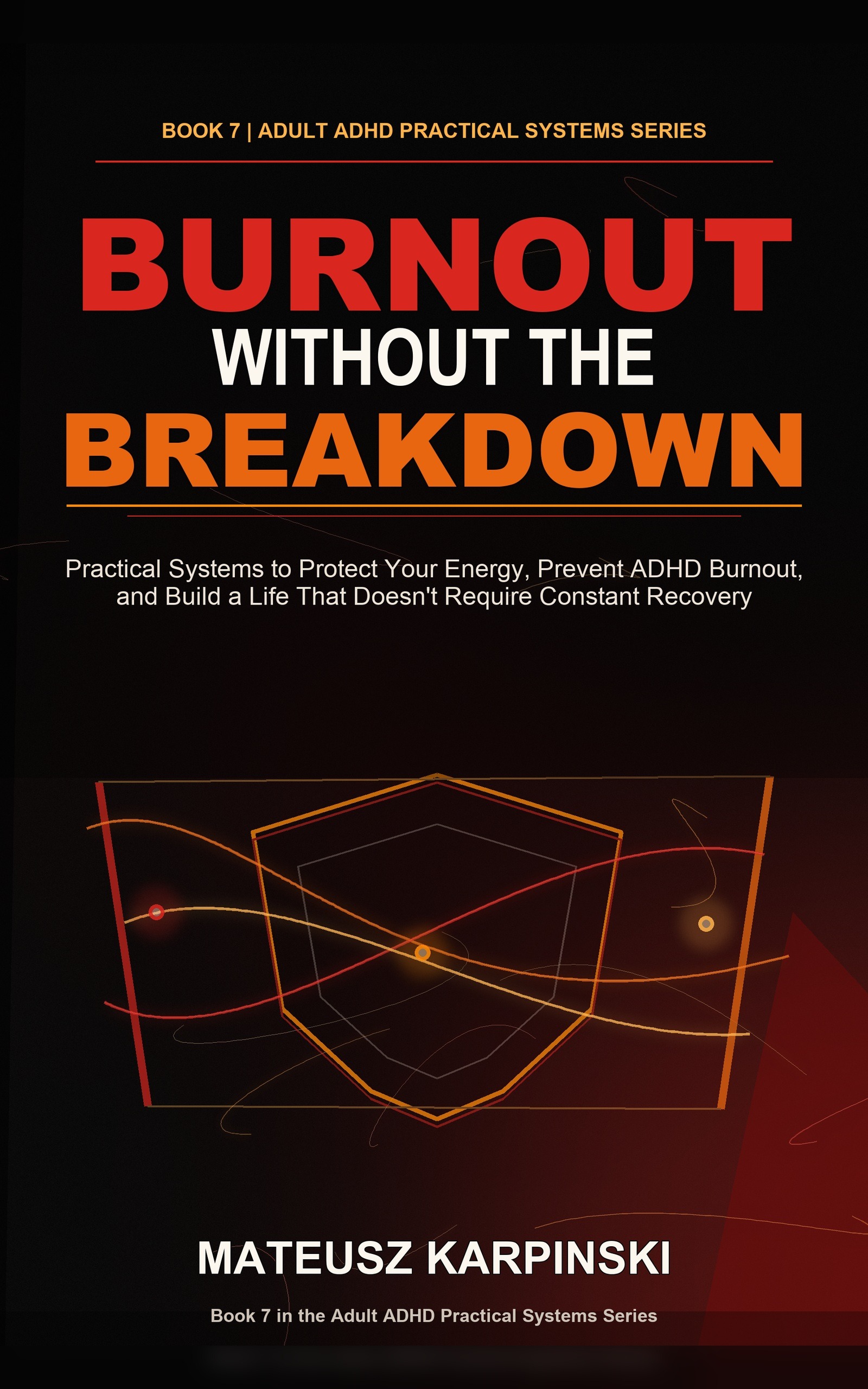
When shutdown starts becoming part of a repeating energy pattern
Book 7 builds the wider energy and recovery system.
This reset helps with one low-capacity moment. Burnout Without the Breakdown adds energy budgets, early warning signs, shutdown rituals, demand reduction, boundaries, and recovery loops for the longer pattern.
FAQ
What does ADHD shutdown feel like?
People use ADHD shutdown to describe a moment when demands, input, choices, or exhaustion have become hard to process or answer. It can look like going quiet, feeling stuck, avoiding messages, losing access to a next step, or needing much less input. Experiences differ, so this page focuses on a small practical response rather than trying to label or diagnose the moment.
What can I do when I feel shut down with ADHD?
Start smaller than a full recovery plan. Lower one immediate demand or input, meet one ordinary body need, use a short holding boundary where appropriate, and leave one visible cue for the next thing.
Do I have to push through an ADHD shutdown?
You do not need to turn the moment into a performance of normal capacity. Where you have room to do so, reduce the number of demands and decisions first. If a response or obligation cannot wait, use the smallest honest next action or ask for the support appropriate to your situation.
Is this medical or mental-health advice?
No. This is an educational organization tool, not medical, mental-health, diagnostic, or treatment advice. Use appropriate professional or emergency support for any situation that needs it.