
Free ADHD Tool
ADHD work re-entry reset
Return to work through one thread and one short window, not by trying to catch up on the whole gap.
Use this when you are returning after leave, a weekend, a rough week, a long stretch of meetings, or just a period when work quietly moved out of reach. You do not need to recreate every detail before you can begin. You need one reasonable place to restart from.
Use this page, copy the prompts into a note, or print it. It is for the first practical work window after a gap: orientation, one thread, and a visible way back tomorrow.
Start with orientation, not the backlog
One thread before every tab
Work will feel larger than it is if the first task is "find everything I missed." Give one real thread a place to begin instead.
Find the next fixed point
Check only the next commitment or deadline that changes what needs attention. This is orientation, not a full calendar audit.
Choose one work thread
Pick the project, client, request, or task that you can reopen now. A reasonable choice is more useful than the perfect priority map.
Give it a short edge
Set a contained work window. The first goal is contact with the work: read the last note, open the file, reply to one necessary message, or write one rough line.
Park the rest visibly
Give other messages, ideas, and requests one holding place. They are not being ignored; they are being kept out of the doorway.
Protect the work re-entry from the inbox spiral
Before opening messages, decide whether there is one time-sensitive item you truly need to see. If there is, handle or capture that one. Then return to the chosen work thread before the inbox turns into the entire day.
First-30-minutes examples
Check the next meeting, open the project document you were already in, and write one rough next section before reading every message from Friday.
Ask one person for the current priority if needed. Choose one task that is still live, then make a 25-minute contact window instead of reconstructing the whole week.
Open the task where you stopped, read only the last visible part, and write the smallest action that would make the project less hidden.
Use the next unclaimed window for one old work thread before the next call. New requests can go into a holding list until the window ends.
Scan for one real deadline or direct request, not every unread message. Set a specific later window for the inbox and return to the selected thread.
A gap is not proof that you have to begin from zero
Returning to work can feel like walking into a room where everyone else kept moving while you were gone. That feeling often makes the inbox, calendar, chat, and task list look equally urgent. They are not. Most of the time, there is one current point of contact that can orient you enough to begin.
Let the first work block be deliberately narrow. The goal is to restore a working relationship with one piece of work, not to prove that the gap never happened. Once one thread is open again, the wider backlog becomes easier to sort into real next steps.
If the scan shows that a deadline has already passed, use the free ADHD missed deadline reset to separate the facts, the next realistic output, and the correct route for reopening the task or contact.
When work keeps vanishing behind messages, meetings, and gaps
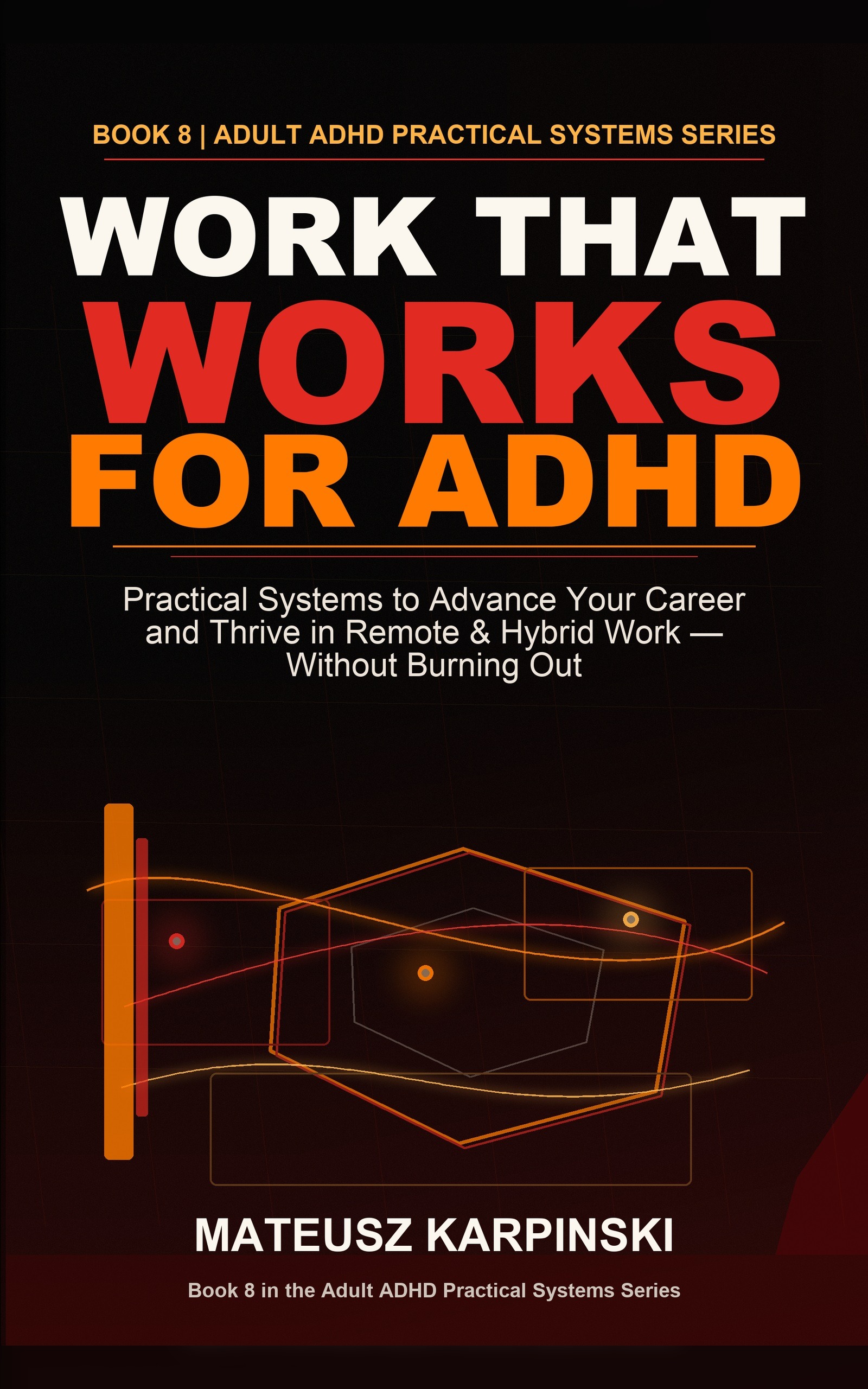
Book 8 builds the system around the return.
This reset gets you through the first work window. Work That Works for ADHD goes further with focus rails, task handoffs, meeting recovery, remote-work systems, and boundaries that make returning to work less costly.
FAQ
What is an ADHD work re-entry reset?
It is a short structure for the first part of a workday after time away, a disrupted week, or a gap in attention. It makes one work thread visible, gives it a small time edge, parks the rest, and leaves a return point for later.
How do I return to work after time off with ADHD?
Start with orientation rather than trying to catch up. Check the next fixed commitment, choose one active work thread, define a small opening action, and give it a short time window before you look at the whole backlog.
Should I clear my inbox first after a break?
Not necessarily. A full inbox can swallow the whole re-entry window. First identify whether there is one time-sensitive message or task, then return to a selected work thread. You can give the inbox a contained time later.
Can I use this after a bad workday, not only time off?
Yes. Use it whenever work feels distant or crowded: after a hard day, a stretch of avoidance, a long meeting run, a leave day, or any gap that made the next work action hard to find.